
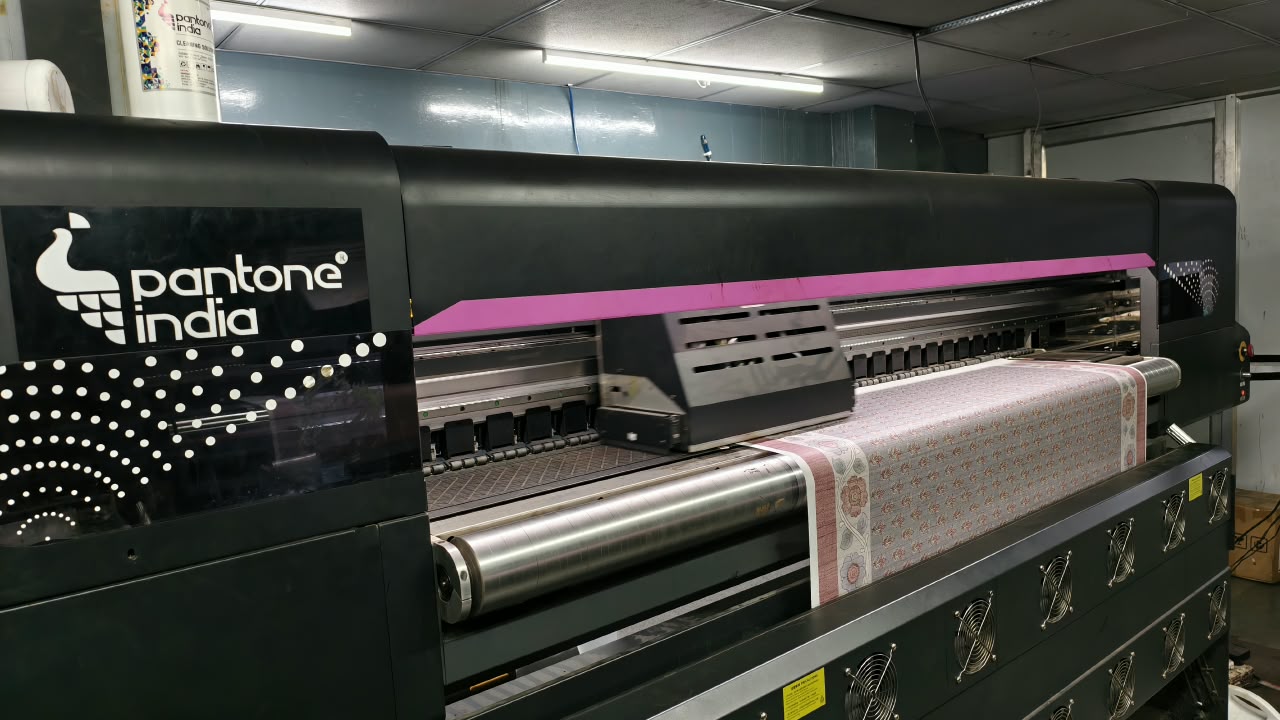
Beyond the Printhead: What Truly Drives Inkjet Printing Quality?
A common misconception is that the printhead is the single factor determining an inkjet printer’s image quality. In reality, achieving exceptional output is far more complex.
Even when two machines are equipped with identical printhead models, their final print quality can vary significantly due to differences in:
- Position Detection Accuracy: Ensures precise drop placement across the substrate.
- Motion Control: Dictates the smoothness, acceleration, and alignment of carriage movement.
- Mechanical Structure: Minimizes vibration and maintains rigidity during high-speed operations.
- Ink Performance: Influences surface tension, viscosity, dry time, and color density.
- Printhead Driving Technology: Governs voltage, waveform design, and firing frequency for optimal droplet formation.
While a high-quality printhead provides the foundation for accurate ink ejection, the entire printing system—including the encoder system, motion mechanics, and ink delivery workflow—is what ultimately determines whether a machine achieves its full performance potential.
This article explores the key factors behind inkjet printing accuracy and uncovers why the exact same printhead can deliver completely different results on different machines.
The Printhead: The Foundation of Ink Droplet Precision
The printhead is the primary engine behind digital image creation. Its design and hardware capabilities dictate the maximum achievable resolution and physical precision of any printing system.
- Nozzle Density and Resolution Capability
Nozzle spacing directly dictates how finely a printhead can deposit ink onto a substrate. High-performance industrial printheads incorporate thousands of micro-nozzles within a compact footprint, enabling high-resolution rendering for:
- Micro-text and fine detail
- High-density barcodes and QR codes
- Complex graphic illustrations
- Precision technical patterns
While dense nozzle configuration provides the capability for fine detail, true output quality relies heavily on the performance consistency of every individual nozzle.
- Droplet Dynamics and Image Sharpness
Modern industrial piezoelectric printheads rely on customized voltage waveforms to govern fluid dynamics. Precise electrical control directly regulates key ejection parameters, including:
- Droplet volume (picoliter scale)
- Velocity and trajectory
- Firing stability across frequencies
Ultrafine droplet volumes minimize graininess to deliver smooth tonal gradients, crisp line edges, and vibrant detail. Conversely, subtle variations in drop size, speed, or flight angle will introduce defects such as line blur, edge distortion, and color registration errors—regardless of how precise the machine’s motion system may be.
Here is a polished, professional version of your text, organized with clear headings and formatting for maximum readability:
Encoder Strips, Mechanical Systems, and Ink Dynamics: The Pillars of Print Accuracy
While the printhead dictates where ink is created, the overall mechanical and motion control infrastructure determines how accurately that printhead is positioned.
The Encoder Strip: Precision Position Detection
Inkjet printers commonly rely on optical encoder technology based on the Moiré fringe principle to track movement.
The encoder system consists of three main elements:
- Encoder Scale (Grating Strip): Features thousands of precisely engraved lines.
- Optical Sensor: Reads changing light patterns as the carriage moves.
- Signal Processing System: Translates sensor data into exact carriage coordinates.
Finer grating pitches increase the position sampling resolution, enabling microscopic movement control. However, if the encoder strip accumulates dust, ink contamination, or scratches, the optical signal destabilizes. This leads to common print defects such as:
- Double images
- Horizontal banding
- Color registration errors
- Misaligned graphics
Note: A high-performance printhead cannot compensate for inaccurate positioning feedback caused by a dirty or damaged encoder strip.
- Mechanical Motion Systems: Hardware Stability
While the encoder system supplies position data, physical hardware executes the movement. Professional inkjet printers depend on the seamless coordination of timing belts, linear guides, motors, servo systems, and the carriage framework.
- Belt and Guide Rail Accuracy: Smooth carriage travel is essential. Incorrect belt tension, guide rail deviation, or mechanical vibration introduce positioning errors that compromise high-resolution output.
- Servo Feedback Closed-Loop Control: Advanced printers utilize servo motors driven by encoder feedback. The system continuously compares target positions against actual positions, instantly adjusting speed and alignment to maximize reliability and consistency.
- Ink Performance: The Material Factor
Ink is an active component of the printing system, and its rheological properties directly govern droplet formation:
- Viscosity: Must align precisely with the printhead design. High viscosity causes unstable ink flow and nozzle starvation, while low viscosity leads to erratic droplet formation and poor edge sharpness.
- Surface Tension: Controls droplet shape upon impact and determines how the ink spreads across the substrate.
- Degassing and Air Bubble Control: Entrapped air bubbles inside improperly degassed ink cause missing nozzles, intermittent firing, and broken lines. Stable ink supply and filtration are critical to preventing these defects.
Summary
Two printers equipped with identical printheads can still yield completely different results because the printhead is only one part of an integrated, highly sensitive mechanical and fluidic ecosystem.
How Manufacturers Master Inkjet Printing Accuracy
Achieving stable, high-quality output requires printer manufacturers to optimize the entire printing system rather than relying solely on the printhead.
Key System Optimization Areas
- Selecting the Ideal Printhead: Match hardware capabilities directly to application needs—whether prioritizing high-speed production, ultra-fine graphic detail, high-gap printing, or industrial coding.
- Elevating Encoder Precision: High-resolution optical encoder strips and advanced sensors deliver sub-micron positioning accuracy, superior repeatability, and minimal image distortion. Regular maintenance and clean optical pathways remain vital.
- Refining Mechanical Design: Rigid structural frameworks, heavy-duty linear rails, and balanced carriage assemblies eliminate vibration to ensure smooth, predictable motion control.
- Matching Fluid Dynamics to Hardware: Tailor ink formulations—viscosity, surface tension, and drying characteristics—to the specific printhead architecture, droplet volume, firing frequency, and substrate material.
Conclusion: Printing Accuracy Is a System, Not a Single Component
While the printhead remains the core engine of drop formation, image quality is ultimate driven by system synergy:
- The Printhead controls droplet formation and jetting dynamics.
- The Encoder System provides real-time positional accuracy.
- The Mechanical Structure ensures smooth, vibration-free carriage travel.
- The Ink Supply System delivers stable fluidics and precise drop formation.
The seamless integration of printhead technology, motion control, and fluid engineering is what enables industrial inkjet printers to deliver sharp detail, vivid color registration, and dependable long-term performance. Ultimately, true printing accuracy is achieved when every component across the machine operates in total harmony.
Leave a Reply